HyperStore Object Storage Software

Enterprise-scale data management for capacity-intensive workflows.

Get the Object Storage Buyer’s Guide

Limitless Scale.
Maximum Security. AI Ready.

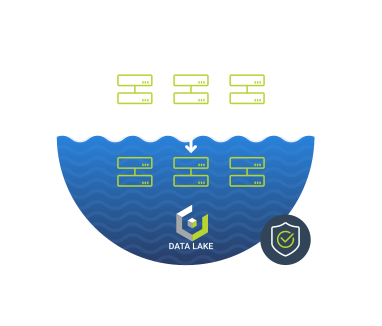
The Cloudian HyperStore AI Data Lake puts you in control with full data sovereignty, robust data protection, and ransomware defense. Proven in the most demanding large-scale workloads, HyperStore delivers enterprise security and durability for massive volumes of unstructured data.

Capabilities and Benefits

Exabyte Scale

Start small and grow without limit. The HyperStore architecture is built for the world’s most capacity-intensive workloads with a modular design that delivers non-disruptive expansion and scalable performance. Grow at one site, or distribute storage across multiple sites, and manage it all as one system.

Military Grade Security

HyperStore delivers the ultimate in data security with the industry’s most complete set of security certifications. Key features include secure multi-tenancy, data encryption in transit and at rest, KMIP, role-based access controls, IAM, integration with SAML, MFA, Secure Shell, and Object Lock for ransomware defense.

Hardware Freedom

HyperStore is software-defined storage that runs on industry-standard hardware. Choose from fully-supported appliances from Cloudian, or deploy HyperStore on the server you prefer. Save cost now and in the future with CAPEX savings of up to 70% compared to traditional tier one storage systems​​ with proprietary hardware.

Highest S3 Compatibility

S3 API compatibility is crucial for seamless integration with cloud-native applications and services. Cloudian HyperStore delivers the industry’s highest S3 API compatibility, ensuring full support for AWS S3 features and operations. The AWS S3 SDK is our SDK. This enables effortless data management, data migration, and trouble-free interoperability across hybrid and multi-cloud environments, enhancing flexibility and reducing complexity.

Unified File and Object

Unified file and object management streamlines data operations, reducing complexity and costs by managing diverse data types under a single system. Cloudian HyperStore delivers unified management with its seamless support for both file and object storage, providing a scalable, efficient solution that enhances data accessibility, governance, and operational efficiency.

Bi-Modal Data Access

Bi-modal data access is essential for modern applications, allowing simultaneous support for legacy and cloud-native workloads. Cloudian HyperStore makes all unstructured data accessible to all of your applications.  It significantly streamlines your workflow by simplifying data accessibility across diverse environments.

Accelerates media workflow with hybrid cloud

Watch video

“With Cloudian, DR became automatic. We store data to the archive and it’s automatically replicated to the cloud. That’s a lot simpler and more reliable than managing tapes.”​​

Shane Miner​ Senior Director of Technical Services

Purpose-Built for Enterprises

Robust Data Protection, No Matter What Fails

Most storage systems protect against drive failure. HyperStore can protect against drive failure, node failure, rack failure, and complete site failure. Erasure coding distributes data fragments across nodes (or across racks and data centers), so every object remains fully recoverable even when multiple components fail at once. Configure whatever level of data durability is required. Replication is also available where lower latency outweighs storage efficiency. Either way, the protection scheme is set per bucket letting you set the optimal configuration for each data type. Because the architecture is peer-to-peer with no central controller and no single point of failure in the data path, resilience is a property of the system itself rather than a feature layered on top.

The More You Scale, the Better 
It Performs

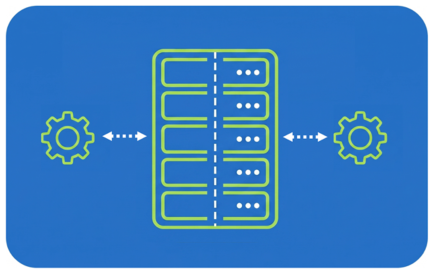
Traditional storage hits a wall as it grows: every request funnels through the same controllers. Adding capacity does nothing to relieve the bottleneck. HyperStore takes the opposite approach. Built on a shared-nothing, peer-to-peer architecture, every node participates equally in serving I/O — there is no metadata server, no head node, no central choke point. Add a node and you add CPU, memory, network, and disk to the cluster simultaneously, with throughput scaling linearly alongside capacity. It's a model purpose-built for AI training and inference pipelines, analytics, and other high-throughput workloads where data volumes and performance demands rise in lockstep.

Global Storage, Without the 
Global Complexity

Most enterprises store data across multiple data centers, edge sites, and cloud regions. Managing that sprawl quickly becomes a full-time job. HyperStore presents distributed infrastructure as a single, flat S3 namespace, accessible through one set of credentials and one management plane. Placement, replication, and lifecycle policies are applied per bucket and enforced automatically: data can be replicated synchronously between sites for active-active access, asynchronously for disaster recovery, or tiered to public cloud as it ages. Whether you're operating two sites or twenty, the experience is the same: one system, one view, and one set of tools to manage it all.

True Multi-Tenancy, Built into 
the Platform

Multi-tenancy in HyperStore isn’t a deployment pattern bolted on. It’s a core property of the platform. A single cluster supports many independent tenants, each with its own users, groups, IAM policies, and role-based access controls. Resources are pooled and allocated dynamically rather than statically partitioned, so a tenant’s capacity and performance can grow without re-provisioning, while per-tenant QoS controls enforce throughput and request-rate limits to prevent noisy-neighbor effects. Encryption keys, compression, consistency, and storage policies can be configured independently for each tenant, and tenant data is isolated not only from other tenants but from the service provider itself. Per-user metering produces the usage records needed for chargeback or billing. The result is a platform that runs at cloud scale while keeping each tenant logically and operationally its own environment.

Get Started With Cloudian Today